This weekend marks the first year
It’s been a full year this weekend since Derek, Aaron, and I drove out to tidewater Virginia to pick up the old car. At that time I was thinking that I’d be driving the car a year after picking it up. But experience has taught me otherwise. I think we have made good progress nonetheless. It was my expectation that was out-of-line.
We’re watching Hurricane Isabel with some dread this weekend. It could end up being another Fran, some say, or worse. I just hope that the storm turns out to sea. There isn’t much to do about it except stockpile some water and make sure the flashlight works.
Pistons removed
I was thinking about a gradualist approach to remove the pistons, but I am thinking better of it now. We decided to remove the whole lot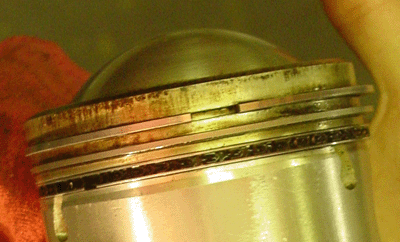 of them all together, so that we can take a closer look at the crankshaft. I spoke with my dad on the telephone over the weekend about the crankshaft. He tried replenishing bearings on an old engine once before, and they gave way shortly afterward. If the crankshaft is not true — if it has miniscule flatnesses especially — the crankshaft eats up the new bearings in short order. So, I’m going to look around for a machine shop that can check the crankshaft in all of its places and, if need be, turn and otherwise repair it.
As my dad said, now is the time to do it, when the engine is out and already apart. If the bearings fail and the crankshaft is the problem, doing the work later will be even more frustrating.
The piston rings look quite good. The two at the top are supposed to have a taper that narrows at the bottom, and these seem to have that shape still. I would have expected worn rings to be virtually square from wear. The lowest ring is actually composed of three parts: two solid and very thin rings surrounding a chain-like spacer. This assembly is the so-called “oil ring” — probably because it keeps most of oil in the crankcase and not spilling into the firing chamber above the pistons.
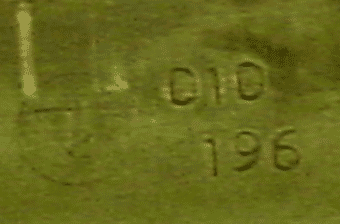
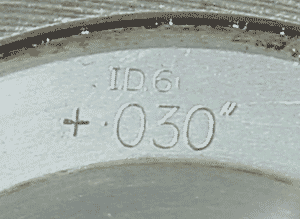
I haven’t looked everything up yet, but I’m thinking that the bearings that we took off the piston rods were the 0.010 inch oversize versions. Not only do the markings suggest that, but that kind of wear would fit with the 0.030 inch oversize of the pistons. From what I can tell that size bearing is the maximum as well.
Rear body shell block-sanded
I began block-sanding the body shell. It is a little tedious, but I am amazed at how something as simple as block-sanding can tease out slight imperfections in the body shape. I’ve been marking them with masking tape as I go along. Many are slight dips or flatnesses in inappropriate places, usually at a spot where we had to do a little repair or where panels meet. One area that appeared with the sanding was in a place I wasn’t expecting, just above the left rear wheel well on the rear quarter panel. I suspect that the car was bumped at some time or another and very lightly dented. We probably removed a smattering of Bondo when we stripped the paint and didn’t see (or feel) the flatness.
I was hoping to fire up the air compressor and let Aaron have a go at applying some primer, but I think now that block sanding the remainder of the body shell and making some final repairs would be a better idea. Then we can take on the entire body shell in one day, or at least the top portion. We are going to use some POR-15 “Tie-Coat Primer” which is formulated to bond to cured POR-15. We might not have needed it, actually, since the block-sanding is making the surface rough enough for regular primer to bond to. I already have the Tie-Coat Primer, at any rate.
I’ll post pictures of the marked up car later on. Block-sanding is really important, but it’s easy to overlook because spraying primer is a heck of a lot more fun!
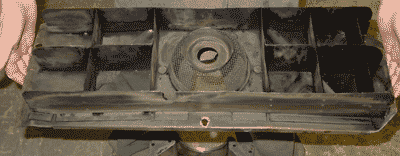
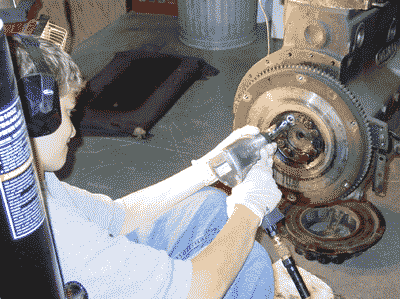 and was delighted that we could walk away with ours for under $40 USD. We hadn’t really explored the engine — like the removal of the oil pan to inspect the crankcase area — and the engine stand made this much more possible. Most engine stands connect to the engine by the bolts used to attach the bell housing at the rear end of the engine block. (I’m not sure exactly how new-fangled sideways engines are attached to their engine mounts. I assume that there is a wholly different breed of engine stands for such engines.)
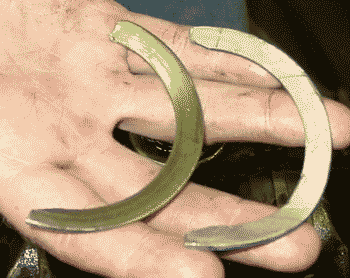 At this point we have not investigated the damage that may (or, we hope, may have not) been caused by the lack of thrust washers. They were a bit of a mystery at first, since they obviously were not crankshaft bearings and they gave the impression of being halves of a single large washer that was split. The thrust washers fit on both sides of the middle crankshaft support. I think they stabilize the crankshaft from forward and backward movement, though I don’t know how critical they are, since it would seem to me that most of the strain on the crankshaft would be vertical and horizontal — coming from the up and down motion of the pistons. A cursory look at the middle support and the surrounding fittings revealed no apparent damage. We’ll need to see about the wear in this area, just to see if the section is so large that the thrust washers won’t fit snugly.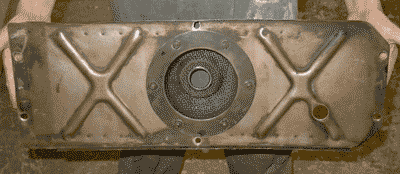
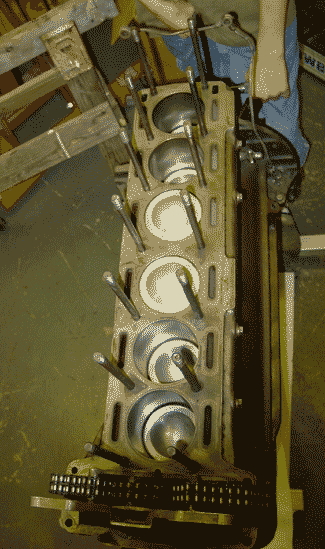 I suppose this wasn’t really necessary at this point, but it can do nothing but good to remove some of the collected grit from the cylinders and pistons. This cleaning had the benefit of allowing us to see markings on the pistons that show that these pistons are oversized by 0.030 of an inch. That is the largest size that Jaguar recommends before resleeving the cylinders and resizing the pistons to their initial measurements. The markings also confirm absolutely that the engine has been overhauled (not an unusual thing, of course — it would be far more unusual to find an engine of this vintage that had not been overhauled).
 a time, to replace the rings and bearings. Then after one is back in place, we’ll remove the next one, and so on. This, of course depends on whether we’ll need to remove the crankshaft to do whatever needs to be done about the thrust washers. At this point, however, I’m thinking that the issue with the thrust washers was a matter of incorrect installation or perhaps a misfit of part. As a matter of fact, it’s not clear to me that the thrust washers were in fact replaced at the last overhaul. The ones that were mangled may indeed have been the originals. I don’t know yet.